
The automotive industry offers a wide range of auto dealership positions for people with different skills, education levels, and career goals. A dealership is much more than a showroom filled with vehicles. Behind every sale is a team of sales consultants, finance professionals, customer-service representatives, technicians, parts specialists, administrators, marketers, and managers. Current automotive job listings demonstrate the variety of opportunities available across sales, service, finance, customer experience, marketing, and dealership operations.
Whether you enjoy working with customers, repairing vehicles, managing employees, analyzing numbers, or promoting products, there may be a dealership career that matches your strengths. Understanding the different departments and responsibilities can help you choose a path that fits your experience and long-term goals.
Understanding How a Car Dealership Works
A modern dealership typically operates through several interconnected departments. The sales team focuses on selling new or used vehicles, while the service department handles maintenance and repairs. Parts departments supply components, and finance teams help customers arrange vehicle purchases.
Other important functions include marketing, customer relationship management, administration, inventory control, human resources, and management.
A dealership’s success depends on these departments working together. A customer may first encounter a salesperson, then work with a finance specialist, receive service from technicians later, and communicate with a customer-relations representative throughout the ownership experience.
Major Dealership Career Categories
There are several broad career paths within automotive retail.
| Department | Common Roles | Primary Focus |
|---|---|---|
| Sales | Sales Consultant, Sales Manager | Vehicle sales and customer relationships |
| Finance | Finance Manager, F&I Specialist | Loans, contracts, and financial products |
| Service | Technician, Service Advisor, Service Manager | Repairs and vehicle maintenance |
| Parts | Parts Advisor, Parts Manager | Parts inventory and customer support |
| Customer Experience | CRM Executive, Customer Relations | Customer satisfaction and retention |
| Marketing | Marketing Executive, Digital Specialist | Leads, advertising, and brand promotion |
| Management | General Manager, Department Manager | Operations and business performance |
| Administration | Billing, HR, Office Staff | Internal dealership support |
Each department requires a different combination of technical, communication, organizational, and leadership skills.
Sales Consultant
The sales consultant is one of the most visible positions in a dealership.
Sales professionals interact directly with potential buyers, identify their needs, explain vehicle features, arrange test drives, discuss pricing, and follow up with leads. Current dealership listings commonly seek candidates who can communicate effectively, understand customer needs, explain vehicle features, and follow up with prospects.
Typical Responsibilities
A sales consultant may:
- Greet showroom visitors
- Respond to online and telephone inquiries
- Explain vehicle features
- Arrange test drives
- Discuss financing options
- Prepare sales paperwork
- Follow up with potential customers
- Maintain customer relationships
- Work toward sales targets
This role can be attractive to people who enjoy meeting new people and working in a performance-oriented environment.
Sales Manager
Sales managers supervise the dealership’s sales operation.
They may manage sales consultants, monitor targets, review inventory, coordinate promotions, analyze performance, and help resolve difficult customer situations.
Experience in vehicle sales is often valuable for this role because managers need to understand the complete sales process.
Skills for Sales Management
Successful sales managers often need:
- Leadership
- Negotiation skills
- Customer-service ability
- Sales analysis
- Team motivation
- Communication skills
- Knowledge of vehicle products
- Problem-solving ability
A salesperson who consistently performs well may eventually progress into a team-lead or management role.
Finance and Insurance Specialist

Finance and insurance, often called F&I, is another important dealership function.
F&I professionals work with customers after they agree to purchase a vehicle. They may explain financing arrangements, contracts, warranties, insurance-related products, and other available services.
Because this position involves financial documents and customer decisions, attention to detail is extremely important.
Why F&I Can Be a Strong Career
People who enjoy numbers, sales, compliance, and customer interaction may find this area particularly attractive.
The position can also provide opportunities to move into senior finance or dealership management roles.
Service Advisor
Service advisors act as a bridge between customers and the workshop.
When a vehicle owner brings a car in for maintenance or repair, the service advisor listens to the customer’s concerns, records the requested work, communicates with technicians, provides estimates, and updates the customer.
Important Skills
Service advisors benefit from:
- Strong communication
- Automotive knowledge
- Organization
- Customer-service skills
- Time management
- Ability to explain technical information clearly
A good service advisor does not necessarily need to perform the mechanical work personally. Instead, the role focuses heavily on communication and coordination.
Automotive Technician
Technicians handle the technical side of dealership operations.
Their work may include inspections, routine maintenance, diagnostics, repairs, electrical systems, braking systems, suspension, engines, transmissions, and increasingly complex electronic systems.
As vehicles become more technologically advanced, technicians may need knowledge of computer-based diagnostic equipment, electronics, hybrid systems, and electric vehicles.
Career Development for Technicians
A technician can potentially progress through several levels:
- Apprentice or trainee
- Junior technician
- Experienced technician
- Diagnostic specialist
- Senior technician
- Workshop supervisor
- Workshop or service manager
Technical training and hands-on experience are particularly important for this career path.
Parts Advisor
Parts professionals help ensure that technicians and customers receive the correct components.
Their responsibilities may include checking inventory, ordering parts, identifying components, processing invoices, and communicating with suppliers.
A parts advisor needs to be organized and detail-oriented because ordering an incorrect component can delay repairs and affect customer satisfaction.
Parts Manager
A parts manager oversees the dealership’s parts operation.
Typical responsibilities can include:
- Inventory management
- Ordering
- Supplier relationships
- Stock control
- Pricing
- Department profitability
- Staff supervision
- Parts forecasting
Current dealership career listings include parts-management positions alongside service and technical roles.
Customer Relationship Management Roles
Customer relationship management, or CRM, has become increasingly important in automotive retail.
CRM professionals may track customer leads, organize follow-ups, monitor communication, and help sales teams respond to inquiries quickly.
A dealership can receive leads through websites, social media, telephone calls, advertising campaigns, and online vehicle marketplaces.
CRM staff help make sure these opportunities are not overlooked.
Digital Marketing and Social Media
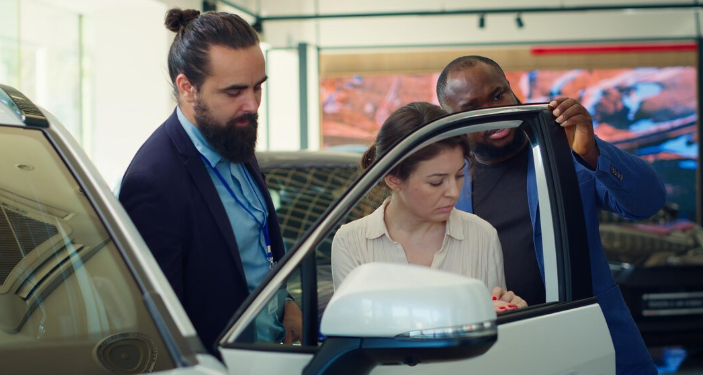
Modern dealerships increasingly rely on digital marketing to attract customers.
Marketing professionals may manage:
- Social media
- Search advertising
- Email campaigns
- Website content
- Online vehicle listings
- Promotional campaigns
- Customer reviews
- Lead-generation activities
Current automotive job listings include digital marketing and brand marketing positions within dealership-related businesses.
People interested in marketing can therefore build an automotive career without working directly in vehicle sales.
General Manager
The general manager has responsibility for the dealership’s overall performance.
This is a senior position that can involve overseeing sales, service, finance, parts, customer satisfaction, staffing, inventory, and financial performance.
General managers need broad business knowledge rather than expertise in only one department.
Skills Needed for Senior Management
Important qualities include:
- Leadership
- Financial understanding
- Strategic thinking
- Decision-making
- Team management
- Customer focus
- Sales knowledge
- Operational awareness
Many dealership leaders develop their careers by progressing through one or more departments before taking on broader responsibilities.
Other Important Dealership Positions
A dealership may employ many additional specialists.
Examples include:
- Inventory manager
- Receptionist
- Cashier
- Billing executive
- Human resources professional
- Administrative assistant
- Warranty administrator
- Delivery coordinator
- Fleet sales specialist
- Used-car manager
- Body-shop advisor
- Quality inspector
- Vehicle photographer
- Call-center representative
- Accessories specialist
- Security personnel
The exact organizational structure differs depending on dealership size, brand, location, and business model.
An automotive-sector workforce study describes dealership structures that include general management, sales, inventory, exchange, HR, accessories, administration, auto finance, MIS/EDP, and call-center functions.
Entry-Level Opportunities
Not every dealership position requires years of experience.
Entry-level opportunities may include:
- Sales trainee
- Customer-service representative
- Receptionist
- Call-center executive
- Junior CRM executive
- Parts assistant
- Technician trainee
- Administrative assistant
- Delivery coordinator
Sales positions can sometimes be accessible to candidates who have strong communication skills but limited automotive experience. Current job listings, for example, include sales roles that emphasize communication, customer interaction, vehicle knowledge, and sales motivation.
Skills That Employers Look For
Although requirements vary by role, several skills are useful across dealership careers.
Communication
Almost every dealership department interacts with customers or coworkers. Clear communication can therefore be one of the most valuable abilities.
Customer Service
Dealerships depend heavily on customer satisfaction, repeat business, referrals, and positive reviews.
Automotive Knowledge
Understanding vehicles is particularly valuable in sales, service, parts, and technical roles.
Technology
Modern dealerships use customer-management systems, inventory platforms, diagnostic equipment, digital advertising tools, and other software.
Organization
Employees frequently manage appointments, paperwork, customer information, inventory, and deadlines.
Sales Ability
Sales skills are useful not only for salespeople but also for finance, accessories, service, and management professionals.
Education and Training

The educational requirements depend on the position.
A sales or customer-service role may prioritize communication skills and experience over formal technical education. Technical positions generally require specialized automotive training.
For management positions, employers may value experience in dealership operations, business administration, sales management, finance, or related fields.
Training does not stop after hiring. Vehicle technology changes continuously, so employees may receive manufacturer-specific training throughout their careers.
How to Choose the Right Career Path
Start by considering what type of work you enjoy.
If you like meeting people and persuading customers, sales could be a good fit.
If you enjoy mechanical problem-solving, automotive service may be more appropriate.
If you prefer numbers and financial documents, F&I could be worth exploring.
If you enjoy technology and creativity, digital marketing or CRM may be a better match.
If you like organizing people and making business decisions, management could eventually be your goal.
A Simple Career Matching Guide
| Your Strength | Potential Career |
|---|---|
| Communication | Sales Consultant |
| Mechanical ability | Automotive Technician |
| Organization | Parts or Inventory |
| Numbers | Finance/F&I |
| Customer service | Service Advisor |
| Digital skills | Marketing/CRM |
| Leadership | Department Manager |
| Business strategy | General Manager |
How to Find Dealership Jobs
Job seekers can search dealership vacancies through online employment platforms, manufacturer career pages, dealership websites, and specialized automotive job boards.
Current online listings show thousands of automotive dealership-related opportunities across India, including sales consultants, service advisors, sales managers, marketing professionals, CRM roles, and other positions.
When searching, use several related terms instead of relying on one job title. For example, someone interested in sales could search for “automotive sales executive,” “car sales consultant,” “dealership sales,” and “vehicle sales advisor.”
Tips for Getting Hired
Create a resume that emphasizes relevant skills rather than simply listing previous jobs.
Highlight:
- Customer-service experience
- Sales achievements
- Automotive knowledge
- Technical certifications
- Communication skills
- Computer skills
- Leadership experience
- Performance results
For an interview, research the dealership and its vehicle brands beforehand.
Be prepared to explain why you want to work in automotive retail and how your previous experience can benefit the dealership.
Key Points to Remember
- Dealerships employ professionals across sales, service, finance, parts, marketing, CRM, and administration.
- Sales consultants work directly with customers and vehicle purchases.
- Service advisors coordinate communication between customers and technicians.
- Technicians handle inspections, diagnostics, maintenance, and repairs.
- Parts professionals manage components and inventory.
- Finance specialists help customers complete vehicle-purchase financing and related paperwork.
- CRM and marketing teams help dealerships generate and manage customer leads.
- Management positions require broader operational and leadership skills.
- Entry-level opportunities are available in several dealership departments.
- Ongoing training is important as automotive technology changes.
Final Thoughts
Automotive dealerships offer much broader career opportunities than many people realize. A person does not have to become a salesperson or mechanic to build a successful career in the industry. Sales, finance, service, parts, customer relations, marketing, administration, and management all provide different professional paths.
The best choice depends on your skills, interests, experience, and long-term goals. If you enjoy working with people, customer-facing positions may be a strong fit. If you prefer technical problem-solving, service and repair roles can offer a rewarding path. Those with business, financial, or digital skills can also find opportunities throughout dealership operations.
With experience, training, and strong performance, many dealership employees can progress into supervisory and management positions. The automotive retail industry therefore offers opportunities for both newcomers and experienced professionals.
Frequently Asked Questions
1. What are the most common jobs at a car dealership?
Common roles include sales consultant, sales manager, finance specialist, service advisor, automotive technician, parts advisor, CRM executive, marketing professional, and general manager.
2. Do you need automotive experience to work at a dealership?
Not always. Some entry-level sales, customer-service, administrative, and support roles may accept candidates without previous automotive experience, particularly when they demonstrate strong communication and customer-service skills.
3. Which dealership job is best for someone who likes cars?
Several positions can suit automotive enthusiasts, including sales consultant, technician, service advisor, parts specialist, and vehicle product specialist. The best choice depends on whether you prefer customer interaction, technical work, or product knowledge.
4. Can dealership employees advance into management?
Yes. Employees can potentially progress from entry-level roles to team-lead, department-management, and senior-management positions by developing industry knowledge, leadership skills, and strong performance.
5. Where can I find dealership job openings?
You can search manufacturer career pages, individual dealership websites, online employment platforms, and automotive-specific job boards. Current listings show opportunities across sales, service, CRM, marketing, finance, and management.


One thought on “Auto Dealership Positions: A Complete Guide to Careers in Automotive Retail”